

The real disruption from AI isn’t technical; it’s psychological. Here’s how the most valuable leaders are shifting their focus from intelligence to judgment.
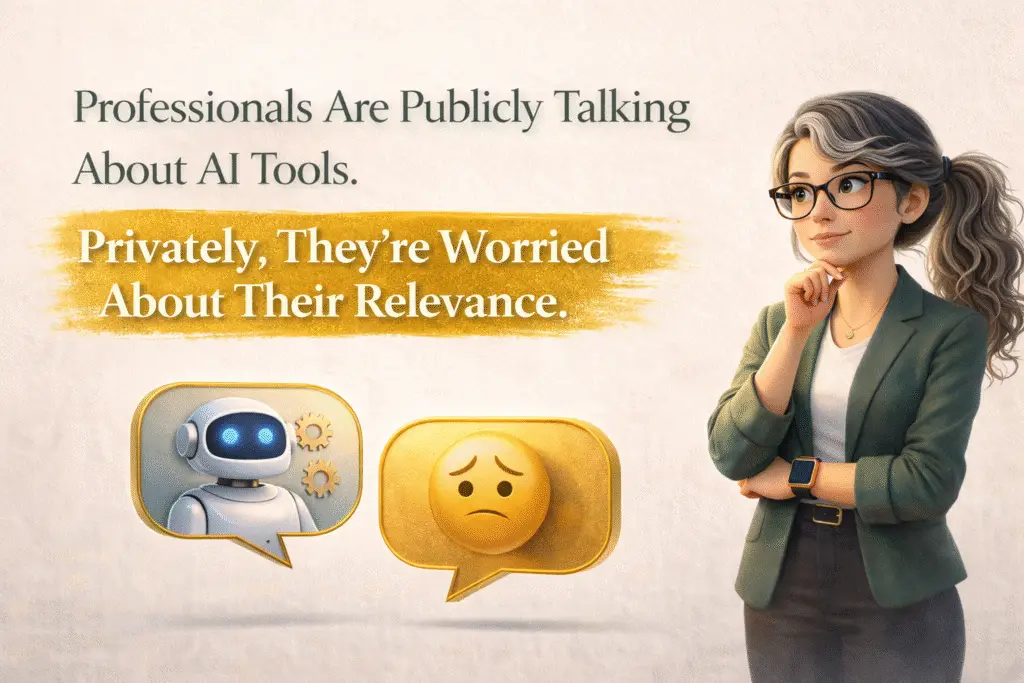
Something interesting is happening in the AI conversation. Publicly, in meetings and on social media, professionals are talking about tools, productivity, and automation. But privately, in quiet moments of reflection, many are thinking about something else entirely: their relevance. This gap between the public discussion and the private anxiety reveals the true nature of the AI disruption. It isn’t just technical. It’s psychological.
What Is the “Human Edge” in the AI Era?
The “human edge” in the AI era refers to the set of durable, non-automatable skills that become more valuable as artificial intelligence makes technical knowledge and productivity abundant. These are not “soft skills,” but critical leadership competencies like judgment, emotional regulation, discernment, and the ability to create meaning. It is the capacity to see clearly, decide wisely, and lead with humanity when information is infinite.
The Identity Disruption
For decades, professional identity and value were built around a specific set of assets: intelligence, expertise, and the ability to produce high-quality work faster than others. AI suddenly makes those things widely and cheaply accessible. This creates a quiet but profound question that many professionals are asking themselves: “If a machine can think with me… what exactly is my value now?”
The real impact of AI isn’t just technological. It’s psychological. And the leaders who thrive will be the ones who develop the human edge machines cannot replicate.
This isn’t just about learning new tools. It’s about a fundamental shift in where our professional value comes from. The advantage is moving from what we know to how we decide.
3 Key Shifts for Staying Relevant in the AI Era
- From Intelligence to Judgment: When intelligence is abundant and accessible to all, the ability to make wise judgments based on incomplete information becomes the rare and valuable skill.
- From Information to Clarity: When information is expanding infinitely, the ability to filter noise, see the signal, and provide clear direction becomes a core leadership function.
- From Answers to Questions: When AI can generate answers instantly, a leader’s value shifts to their ability to ask the right questions—the ones that challenge assumptions and uncover deeper truths.
The C.L.A.R.I.T.Y. Framework: A Process for Developing Judgment
If judgment is the new differentiator, we need a process to cultivate it. The C.L.A.R.I.T.Y. framework is a seven-step method for using AI as a partner to deepen your thinking, not just accelerate your output.
1. Capture the Noise. Use AI tools to get all your raw thoughts, notes, and data out of your head and into a system.
2. Let AI Synthesize. Delegate the “first pass” to AI. Ask it to summarize the raw data, extract key themes, and identify action items.
3. Ask Deeper Questions. With the cognitive load of synthesis handled, use your reclaimed mental energy to ask more strategic questions about the core problem.
4. Reframe with a Sparring Partner. Use AI as a “red team” to challenge your assumptions and reframe the problem from new perspectives.
Step 1: The "Red Team" Challenge
"My current strategy is [describe your strategy]. Act as a skeptical board member and provide the three strongest, most critical arguments against this plan. Identify the single biggest risk I am overlooking."
Step 2: The "Alternative Perspectives" Inquiry
"Now, using the same strategy, prompt the AI: 'Re-evaluate this strategy from the perspective of our most loyal customer, our biggest competitor, and a new employee on their first day. What does each of them see that I might be missing?'"
Step 3: The "Second-Order Consequences" Test
"Finally, prompt the AI: 'Assume my strategy is a success. What are three potential unintended, second-order consequences (positive or negative) that might occur one year from now?'"
5. Integrate Your Intuition. Step away from the technology. Create quiet space to check in with your gut feeling and internal alignment.
6. Time-Block for Discernment. Schedule and protect dedicated time on your calendar for the sole purpose of deep thinking and decision-making.
7. Yield Your Answer. Make your decision with the confidence that comes from a clear, integrated process, yielding an answer from wisdom, not just data.
How This Looks in Practice
A consultant is preparing a recommendation for a client. The “old way” was to spend days researching and writing. The “new way” is to use the C.L.A.R.I.T.Y. Framework. She lets AI Capture and Synthesize market data in minutes. She uses her free time to Ask Deeper Questions about the client’s unstated fears. She uses AI to Reframe her recommendation by arguing against it. After Integrating her Intuition, she Yields her final answer. Her value wasn’t in the research (AI did that); it was in her judgment.
Common Questions About Professional Relevance in the AI Era
- If AI can do my analytical work, what is my value? Your value shifts from performing the analysis to interpreting it. It’s in your ability to add context, exercise judgment, and make a decision based on the analysis—skills AI lacks.
- How do I compete with younger, more AI-native colleagues? You compete on wisdom, not speed. Leverage your years of experience to ask better questions, spot patterns the AI misses, and navigate the complex human dynamics of implementing a strategy.
- Is learning to prompt AI the most important new skill? Prompting is a valuable technical skill, but it is not the most important leadership skill. The most important skill is discernment: the ability to know what to ask, why you’re asking it, and what to do with the answer.
The conversation about AI will continue to evolve. But the underlying psychological disruption is real. The leaders who thrive will be those who stop focusing solely on the tools and start consciously cultivating their human edge. They will shift their focus from knowing more to seeing clearly, and from productivity to judgment.
Your Next Step: Take inventory of your own internal dialogue about AI. Are you more focused on the tools you need to learn, or on the question of how your unique value is evolving? Acknowledging this is the first step.
A Note on the Author’s Philosophy
The ideas in this article are part of a larger leadership framework developed by Simran Kaur. At the foundation is The SACRED Philosophy™, a belief system for powerful and peaceful leadership in a technological world. Building on this is the [BRAND NAME] Operating System, a model that explains how modern leaders navigate intelligence, self-regulation, discernment, and direction in the AI era. The practical tools referenced, such as the C.L.A.R.I.T.Y. framework, are applications designed to help leaders embody these principles. Leaders who wish to deepen their practice move through The A.S.C.E.N.D. Path™, the author’s structured journey for developing aligned, decisive leadership.
About the Author
Simran Kaur is a leadership thinker dedicated to helping professionals navigate the identity and leadership disruption of the AI era. Her work is built on a core belief: that enduring success comes from integrating inner alignment with external strategy. Through her writing and teaching, she provides leaders with the frameworks to develop the “human edge”—the conscious, human-centric skills like judgment, discernment, and emotional regulation that allow them to lead with clarity and feel as successful on the inside as they look on the outside.