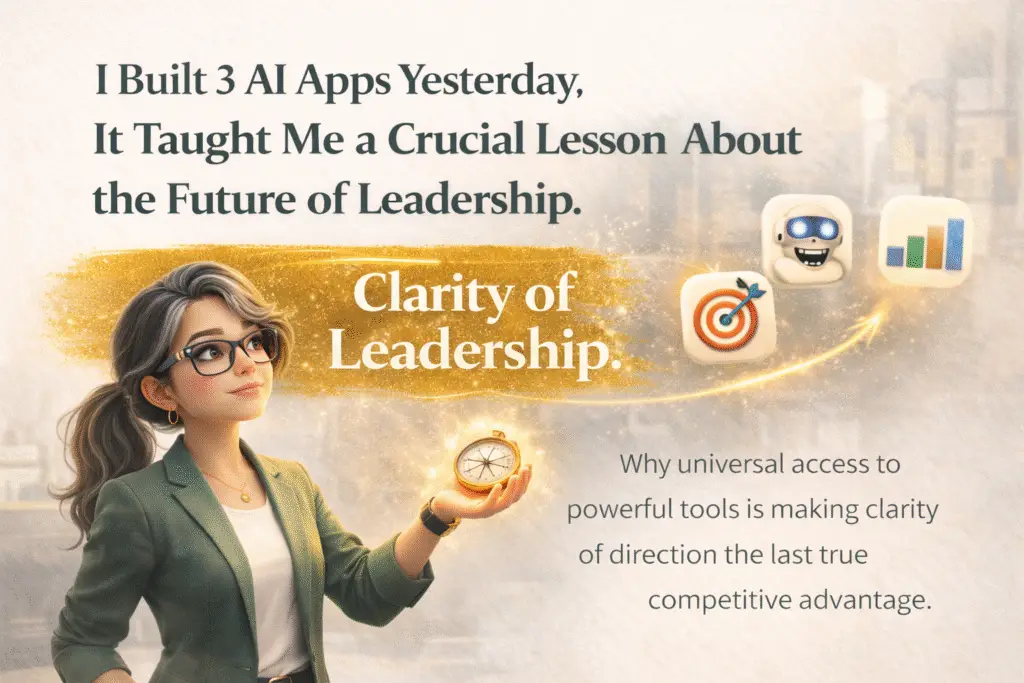
Built 3 apps

I Built 3 AI Apps Yesterday. It Taught Me a Crucial Lesson About the Future of Leadership.

Why universal access to powerful tools is making clarity of direction the last true competitive advantage.

Introduction

Yesterday, for International Women’s Day, a platform called Lovable opened up free AI app building. I decided to experiment. Early in the day, the platform was fluid and fast. I built three simple, useful apps. But by the afternoon, you could feel the surge. The system slowed, clearly under the strain of thousands of people trying to build at the same time. That moment of friction revealed something critical about the new era of work: access to powerful tools is becoming universal, but access is no longer the advantage.

The Democratization of Capability

For a brief moment yesterday, thousands of people had access to the exact same tool, the same technology, and the same opportunity. Some likely experimented a little and then stopped. Some probably got lost, endlessly refining a single idea. And a few, I imagine, walked away with something tangible and useful. The difference wasn’t the tool. It was the clarity of the builder.

When everyone has access to the same capabilities, the differentiator is no longer the tool. It’s the direction.

This is a microcosm of the entire AI revolution. The ability to generate ideas, write strategies, and build applications is being democratized at a breathtaking pace. As author and strategist Ben Thompson (2023) of Stratechery often notes, technology platforms tend to commoditize the layers beneath them. AI is commoditizing the act of “generation.” This means the value has to move up the stack, to the human who knows what to build and why.

Turning Access into Value

Possibility without direction is just noise. To turn the incredible potential of AI into tangible value, you must treat the tool not as a magic wand, but as a clarity partner. This four-step framework is a process for doing just that.

Article content
A.L.L.Y. Framework

1. Archive Your Thoughts. Before you ask an AI what to do, tell it what you’re thinking. Use it as an external brain to capture all your raw, scattered ideas, goals, and open loops. Get the noise out of your head and into the system.

2. Let It Summarize. Delegate the task of finding the signal in your own noise. Ask the AI to review your “brain dump” and synthesize it, extracting key themes, goals, and contradictions. This act of summary often reveals your true direction.

AI Prompt: For Finding Your Own Signal
I've just dictated all my thoughts and ideas for a new community project. The transcript is messy. Act as a strategic analyst. Review the entire text and answer three questions:
1. What is the single most repeated and emotionally charged goal in this text?
2. What are the top 3-5 concrete project ideas mentioned?
3. Is there a core contradiction between my stated goals and my proposed ideas?

3. Leverage It as a Mirror. Once you have a clearer direction, use the AI to reflect and refine it. Ask it to simplify your mission statement, spot assumptions in your plan, or rephrase your value proposition. Use it to make your own thinking sharper, not to replace it.

The tool doesn’t determine the outcome. The clarity of the builder does.

4. Yield to Spaciousness. The goal of using AI as a clarity partner isn’t to become more frantic; it’s to become more focused. By offloading the cognitive labor of organizing and summarizing, you create mental space. Use this “spaciousness” to think deeply, connect with your vision, and lead from a regulated state.

How This Looks in Practice

Imagine two leaders who both get access to a new AI strategy tool.

Leader A (Access-Focused): She jumps in and asks the tool, “What are some good strategies for Q4?” She gets a dozen generic but plausible options. She spends the next week feeling overwhelmed, trying to decide which one is best. She has access, but no direction.

Leader B (Clarity-Focused): Before she touches the tool, she spends 20 minutes writing down her own thoughts on Q4. She then uses the A.L.L.Y. Framework. She asks the AI to Archive and Summarize her notes, which reveals her core goal is “customer retention.” She then Leverages the AI as a mirror, prompting, “Generate three strategies specifically focused on improving customer retention for a SaaS company.” She gets three highly relevant options. She has used her clarity to turn access into value.

The AI era isn’t about who has access to the best tools anymore. It’s about who shows up to the tool with the clearest direction. Yesterday, thousands of people had the same opportunity, but not everyone walked away with something built. Access is expanding. Clarity is, and will remain, the advantage.

Your Next Step: Before you use an AI tool for your next project, take 10 minutes. Write down, in your own words, “What am I actually trying to build here, and why?” This simple act of pre-loaded clarity will transform the quality of your results.

A Note on the Author’s Philosophy

The concepts in this article are part of a larger leadership model developed by Simran Kaur.

  • The SACRED Philosophy™ is the author’s belief system for powerful, peaceful leadership. The A.L.L.Y. framework is a direct application of the D – Digital Wisdom and C – Conscious Technology pillars.
  • The A.S.C.E.N.D. Path™ is the author’s signature coaching journey. Using technology as a clarity partner is a key practice for the C – Clarify Your Truth step, allowing for more effective and intentional action.

References

Thompson, B. (2023). Stratechery. (General reference to his ongoing analysis of technology platforms and commoditization).

Leave a Comment

Your email address will not be published. Required fields are marked *