
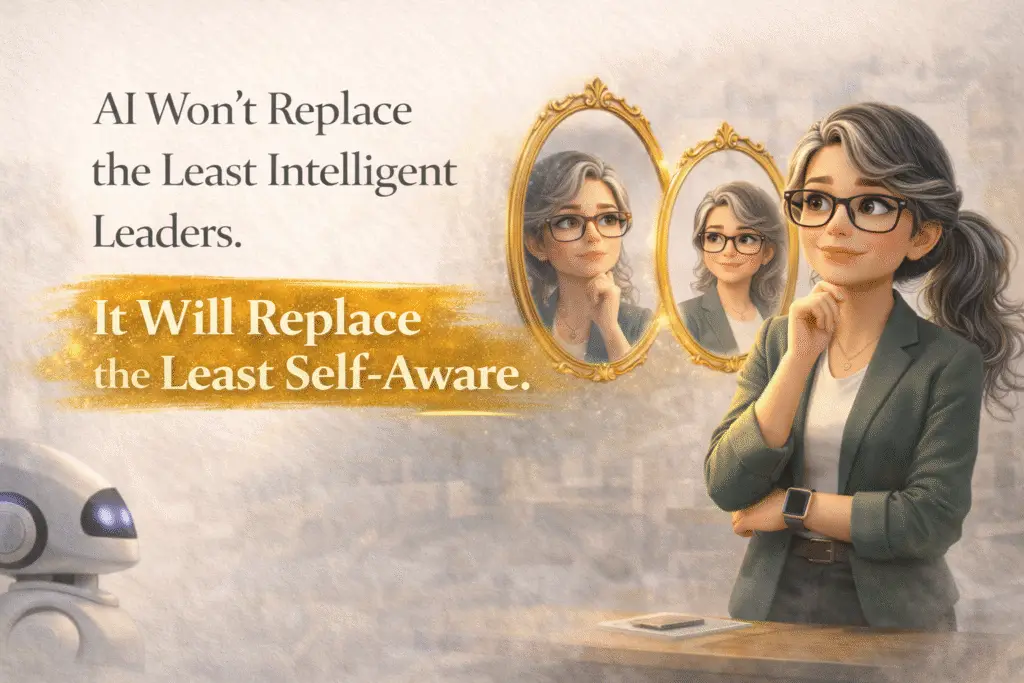

Why the most urgent question for leaders today isn’t “Will AI replace me?” but “What kind of leader am I becoming?”
The question echoes in boardrooms and leadership forums around the world: “Will AI replace leaders?” It’s a question born of anxiety, but it’s also the wrong question. It’s too broad, too generic. It misses the surgical precision with which this technological shift will reshape the landscape of authority. The better, more useful question is this: Which leaders will AI replace first? The answer is not the least intelligent ones. It’s the least self-aware ones.
The Automation of Pattern-Based Leadership
AI is, at its core, an exceptionally powerful pattern-recognition and replication engine. It can analyze historical data, identify best practices, and optimize existing frameworks at a speed and scale no human can match. This is a profound development, because for decades, a significant portion of leadership has been based on exactly these patterns. If your leadership value comes from:
- Repeating established frameworks without deep understanding.
- Copying “best practices” from other companies.
- Optimizing what already exists.
…then you are running a pattern. And AI can run that pattern faster and more efficiently than you can.
AI scales intelligence. But it does not scale consciousness. And leadership ultimately lives there.
This means the leaders who will struggle most are not those with a lower IQ, but those with lower self-awareness. The ones who have been running on autopilot, mistaking pattern-matching for wisdom.
The Shift to Conscious, Integrated Leadership
If pattern-based leadership is becoming a commodity, then the most valuable leaders will be those who offer what AI cannot. The work shifts from rote execution to conscious integration. This new model of leadership rests on a foundation of human-centric, non-automatable skills.

1. From Pattern-Matching to Deep Discernment. AI can tell you what the data says. It cannot tell you what the data means in the unique context of your team’s morale, your company’s soul, or your customer’s unstated needs. This requires discernment: a skill rooted in experience, empathy, and intuition. This is the essence of Spiritual Integration and Authentic Leadership.
2. From Productivity to Presence. AI can scale your output infinitely. It can write your emails, draft your reports, and manage your projects. But it cannot replicate the steady, grounding presence of a regulated human being. In a world of accelerating anxiety, the leader who can remain calm and centered becomes the most valuable person in the room. This is the mastery of Energy Management.