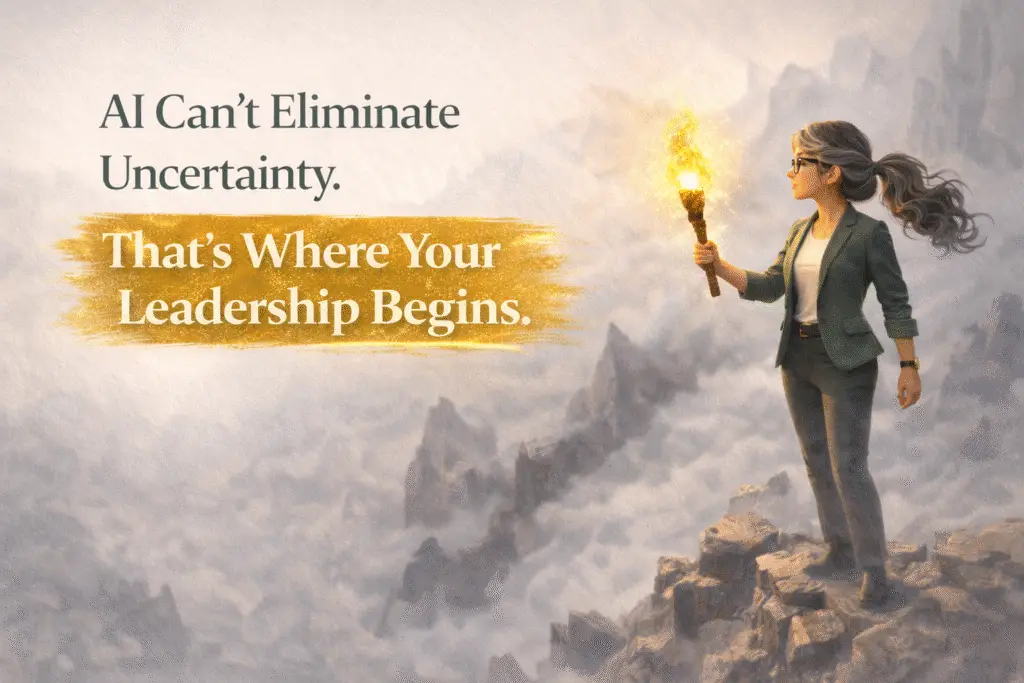
Why the goal of intelligence isn’t to find certainty, but to develop the courage to navigate uncertainty with clarity and responsibility.
Artificial intelligence can generate scenarios, predict outcomes, and model strategies with astonishing precision. It provides leaders with more information than any previous generation has ever had access to. In the face of this data deluge, it’s tempting to believe in a new holy grail: a future free from uncertainty. We believe that with enough analysis, the right path will reveal itself with perfect, risk-free clarity. But this is a dangerous illusion. AI can do many things, but it cannot remove uncertainty. And that is precisely where the real work of leadership begins.
The Myth of Data-Driven Certainty
The core mistake leaders make in the AI era is confusing perspective with certainty. AI is extraordinary at expanding our perspective, showing us possibilities and probabilities we couldn’t see before. But at the end of every analysis, a human being still has to make a choice without a guarantee. As decision science expert Annie Duke (2018) notes in Thinking in Bets, great decisions are not about being right all the time, but about having a sound process for making choices with incomplete information.
Leadership has never been about certainty. It’s about responsibility under uncertainty.
AI can inform the landscape, but it cannot carry the emotional weight of the decision. It cannot absorb the consequences. That responsibility still belongs to the leader, and the attempt to find certainty in data is often a subtle avoidance of this fundamental burden.
Navigating Uncertainty with Clarity
If the goal is not to eliminate uncertainty, then the skill leaders must cultivate is the ability to act with clarity and courage in the face of it. This requires a shift from seeking external validation from data to cultivating internal regulation. This four-step framework is a practice for leading from a place of calm, even when the future is unclear.
1. Check Your State. Before you make a decision under pressure, the first move is to look inward, not outward. Are you feeling activated, anxious, or rushed? A decision made from a reactive state will be a reactive decision. Acknowledging your internal state is the first step toward clarity.
2. Anchor in the Present. If you are activated, regulate your nervous system before you decide. Take three deep breaths. Feel your feet on the floor. This is not a “woo-woo” exercise; it’s a neurological one. As research on emotional regulation shows, calming your physiological state allows your prefrontal cortex, the seat of executive function and good judgment, to come back online (Gross, 2015).
Clarity comes from a steady nervous system, not from endless data.
3. Locate True Responsibility. With a calmer system, ask: “What is truly mine to decide here?” Your responsibility is not to predict the future perfectly. It is to choose the best possible direction based on your values and the available (but incomplete) information. Release the burden of needing to be omniscient.
Act as a leadership coach. I am feeling overwhelmed by the need to make the "perfect" decision about [project]. Guide me through a short reflection exercise to reframe my responsibility. Ask me questions that shift my focus from "predicting the future" to "making the wisest choice with what I know today."
4. Move with Clean Intention. From this place of regulation and clarified responsibility, act. Make the call. Send the email. Announce the direction. Because you are acting from a place of internal alignment rather than external pressure, your action will be “clean”, free from the frantic, anxious energy of uncertainty.
How This Looks in Practice
A founder is looking at AI-generated forecasts showing a potential market downturn. The data is ambiguous. Her nervous system is activated, and she feels an urgent need to either slash her budget (a fear response) or ignore the data (a hope response).
Instead, she uses the C.A.L.M. Framework:
- She Checks her State and acknowledges she feels panicked.
- She Anchors by taking five minutes to breathe and walk around her office.
- She Locates her True Responsibility: not to perfectly predict the economy, but to ensure her company is resilient.
- She Moves with Clean Intention, calling a meeting not to announce drastic cuts, but to initiate a “resilience review” of their budget. The decision is proactive, not reactive. She has navigated uncertainty with clarity.
Intelligence can be automated. Courage cannot. AI can inform your decisions, but it cannot make them for you. It cannot absolve you of the responsibility of choosing a path without a guarantee. Leadership will always live in that uncomfortable, essential space where certainty ends. The goal is not to fear that space, but to learn to navigate it with grace.
Your Next Step: The next time you feel overwhelmed by an uncertain decision, resist the urge to immediately seek more data. Instead, try the first two steps of the C.A.L.M. framework: Check Your State and Anchor in the Present. Notice what shifts when you manage your internal world first.
A Note on the Author’s Philosophy
The concepts in this article are part of a larger leadership model developed by Simran Kaur.
- The SACRED Philosophy™ is the author’s belief system for powerful, peaceful leadership. The C.A.L.M. framework is a direct application of the E – Energy Management and A – Authentic Leadership pillars.
- The A.S.C.E.N.D. Path™ is the author’s signature coaching journey. This practice is foundational to the S – Settle Your System step, which is the gateway to making clear, aligned decisions.
References
Duke, A. (2018). Thinking in bets: Making smarter decisions when you don’t have all the facts. Portfolio/Penguin.
Gross, J. J. (2015). Emotion regulation: Current status and future prospects. Psychological Inquiry, 26(1), 1-26.
