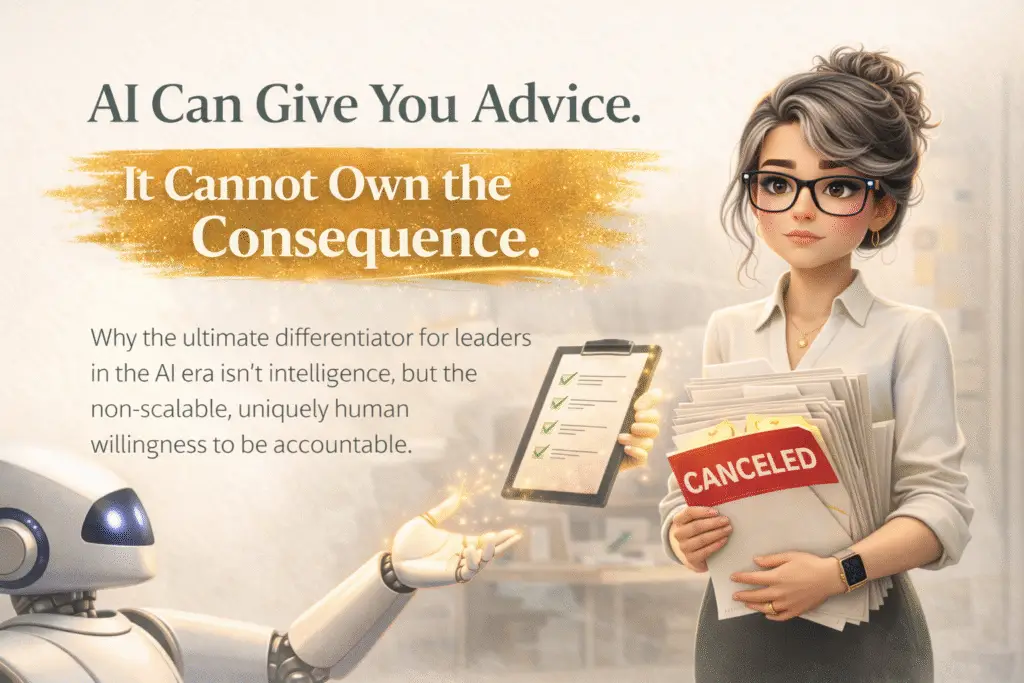
AI Can Give You Advice

AI Can Give You Advice. It Cannot Own the Consequence.

Why the ultimate differentiator for leaders in the AI era isn’t intelligence, but the non-scalable, uniquely human willingness to be accountable.

Artificial intelligence can give you options, analyze scenarios, and suggest strategies. It can model the future with breathtaking speed and complexity. It can, in essence, provide an infinite stream of world-class advice. But there is one critical thing it cannot do. It cannot live with the results. It cannot own the consequence. That responsibility, that final, weighty burden, still belongs entirely to the leader. If you’re using AI to accelerate decisions but still feel the profound weight of your role, this is why.

The Unscalable Nature of Ownership

The great misunderstanding of AI’s role in leadership is confusing intelligence with authority. AI can multiply intelligence on an exponential scale. It can process more data, see more patterns, and generate more advice than any human ever could. But it cannot absorb the consequence of that advice. As ethicist and scholar Shannon Vallor (2016) has explored, virtues like responsibility and accountability are core to human flourishing and cannot be outsourced to a system.

Advice is scalable. Ownership is not.

When a decision goes wrong, you cannot fire the algorithm. When a strategy fails, you cannot put the large language model on a performance improvement plan. A leader, and only a leader, can stand before the team, the board, and the market and say, “I made this call, and I am accountable for the outcome.” This act is the bedrock of authority.

From Advice to Accountability

The journey from receiving advice to taking ownership is the essence of modern leadership. It requires a conscious process of internal commitment before external action. This four-step framework is a practice for holding the weight of that responsibility with clarity and strength.

1. Hear the Discomfort. After the AI has given you all its advice, pause and listen. Not to the data, but to the internal discomfort. What is the source of the weight you feel? Is it the risk? The potential impact on your team? The trade-offs? Acknowledging this “discomfort” is the first step in responsible leadership. It’s the signal that a decision has real stakes.

2. Observe Your Urge. Notice the urge to defer, to ask for one more piece of data, or to find someone else to validate the choice. This is the natural human desire to shed the weight of consequence. Observe this urge without judgment. See it not as a weakness, but as a data point about the gravity of the decision.

Leadership is the willingness to carry consequence.

3. Let the Feeling Be. Before you declare your position, sit with the weight of the decision for a moment. Allow yourself to feel the full spectrum of responsibility. This is not about wallowing in anxiety; it’s about consciously accepting the burden. This quiet moment of acceptance is what forges the internal fortitude needed to lead.

AI Prompt: For Cultivating Accountability
Act as a stoic philosopher. I am about to make a major decision: [describe decision]. I feel the weight of the potential consequences. Guide me through a short, written reflection exercise based on the principles of Marcus Aurelius, focusing on accepting responsibility and focusing only on what is within my control.

4. Declare Your Position. From this place of conscious ownership, make your decision. State it clearly, simply, and with the quiet confidence that comes from having fully accepted the responsibility. You are no longer just sharing advice; you are declaring a direction for which you are accountable.

How This Looks in Practice

A COO is using AI to decide whether to shut down an underperforming but beloved legacy product. The AI’s advice is clear: the data overwhelmingly supports shutting it down to reallocate resources. But the COO feels the heavy weight of the decision’s impact on long-time customers and the employees who built it.

Instead of just acting on the advice, she uses the H.O.L.D. Framework:

Article content
H.O.L.D. Framework
  • She Hears the discomfort—it’s the pain of disappointing loyal people.
  • She Observes her urge to commission another “market study” to delay the decision.
  • She Lets the feeling be, taking an hour to write down the worst-case outcomes and accepting that she is willing to navigate them.
  • She then Declares her position to her team: “I’ve made the difficult decision to sunset the product. I know this is painful, and I take full ownership of this choice and its impact.” Her authority is palpable because it’s grounded in accountability, not just data.

Tools can scale intelligence, but they cannot scale responsibility. And responsibility is the source of all legitimate authority. AI can advise, but it cannot own. The willingness to own the outcome, to live with the results, good or bad, is what still makes someone a leader.

Your Next Step: Think of a recent decision you made with the help of data or AI. Now, consciously say out loud, “I own the outcome of this decision.” Notice how that simple declaration feels. This is the feeling of leadership.

A Note on the Author’s Philosophy

The concepts in this article are part of a larger leadership model developed by Simran Kaur.

  • The SACRED Philosophy™ is the author’s belief system for powerful, peaceful leadership. This article’s focus on ownership is a direct application of the A – Authentic Leadership pillar.
  • The A.S.C.E.N.D. Path™ is the author’s signature coaching journey. The H.O.L.D. framework is a key tool for N – Navigate the Outcome, as it builds the internal resilience to handle the consequences of your decisions cleanly.

References

Vallor, S. (2016). Technology and the virtues: A philosophical guide to a future worth wanting. Oxford University Press.

Leave a Comment

Your email address will not be published. Required fields are marked *