
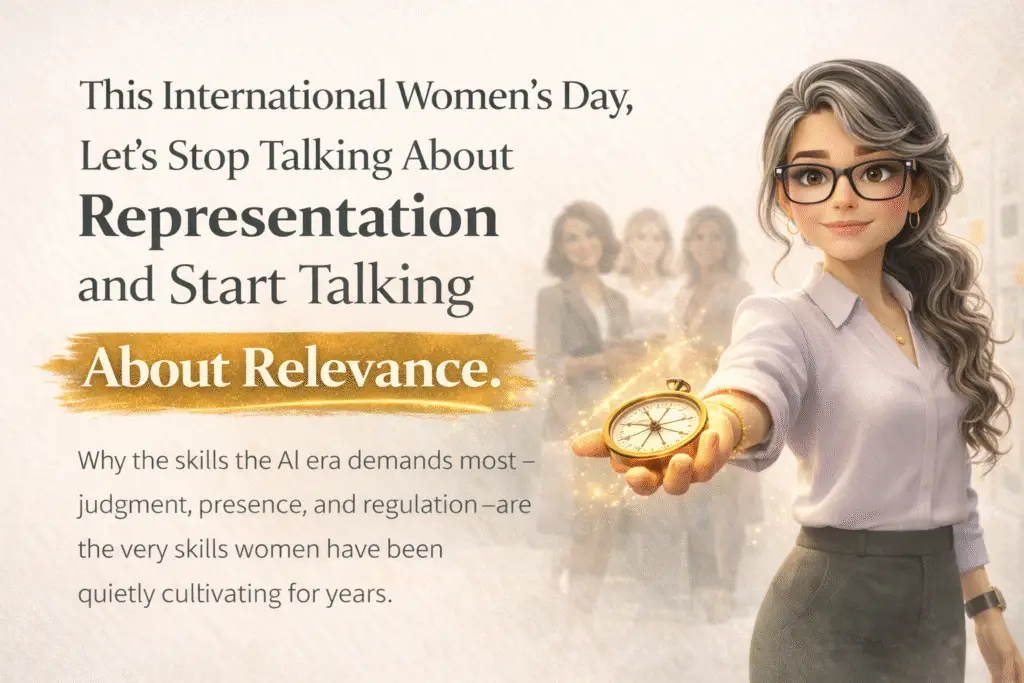

Why the skills the AI era demands most: judgment, presence, and regulation, are the very skills women have been quietly cultivating for years.
The conversation around International Women’s Day often centers on a crucial, but incomplete, metric: representation. We count the number of seats at the table, the percentage of women in the C-suite, the faces in the boardroom. But in 2026, with artificial intelligence rapidly commoditizing intelligence itself, the more urgent question is not just who is leading, but what kind of leadership actually matters. As AI makes output cheap and information universal, a different set of human skills is becoming the key differentiator. And it’s time we recognize who has been mastering them all along.
When Intelligence Becomes Infrastructure
For decades, leadership was often conflated with a certain kind of intelligence: the ability to process information quickly, recall facts instantly, and produce strategies at speed. AI just made that form of intelligence infrastructure, as available and expected as electricity. This forces us to confront what leadership is when it’s stripped of its old signifiers. The value is no longer in production, but in presence. Not in analysis, but in accountability. Not in speed, but in steadiness.
The leaders who will matter most in the AI era aren’t the ones who produce the most output. They’re the ones who can regulate under pressure, discern what actually matters, and choose a direction when the data is endless.
And here is the provocative truth: these are skills many women have been developing for years. Not as a corporate trend, but as a survival strategy in systems that often demanded they be more emotionally intelligent, more regulated, and more discerning just to be heard.
The Integrated Leadership the Future Demands
The leadership the AI era requires is not one-dimensional; it is integrated. It is the fusion of hard intelligence and deep humanity. This is not a new idea, but it has a new urgency. My work is built on a philosophy of six integrated pillars that, I argue, are no longer “soft skills,” but the core competencies for relevant leadership today.
1. Judgment Over Intelligence. AI can generate ten options, but it cannot discern which one is wise. The new value is in selection, not generation. This requires a deep connection to one’s values and intuition, a pillar I call Spiritual Integration.
2. Presence Over Productivity. AI can scale output infinitely, but it cannot scale a leader’s steady, grounding presence. The ability to remain calm and centered in a storm of data is what stabilizes a team. This is the mastery of Energy Management.
Act as a mindfulness coach. I have a day of back-to-back meetings and I feel my energy is scattered. Create a "Transitional Pause" ritual for me—a 90-second exercise I can do between calls to reset my nervous system and enter the next meeting with a calm, centered presence.
3. Regulation Over Reaction. As the pace of information accelerates, the ability to hold complexity without collapsing into a reactive state is paramount. This skill, a cornerstone of Authentic Leadership, ensures that decisions are made from a place of clarity, not anxiety.
4. Accountability Over Advice. AI can provide endless advice, but it cannot take ownership of the outcome. The willingness to be accountable for a decision is the bedrock of authority. This is the essence of Digital Wisdom—using tools as advisors, not as shields from responsibility.
The AI era doesn’t remove the need for leadership. It clarifies it.
How This Looks in Practice
Consider a corporate board facing a crisis. The “old power” model might involve a leader who quickly analyzes data and dictates a reactive, aggressive strategy. The “new power” model, the one demanded by our current reality, looks different. It’s the leader who can hold the tension in the room, listen deeply to all inputs (human and machine), regulate their own fear, and make a decision that is not just data-driven, but wise. This leader demonstrates Relationship Mastery and Conscious Technology. They are not just smart; they are integrated. This integrated model is one that many women have had to embody to succeed.
This International Women’s Day, celebrating representation is still vital. But it’s time to elevate the conversation. The future of leadership requires a profound integration of intelligence and humanity, of data and discernment, of pace and presence. We must recognize that the very skills that were once dismissed as “soft” are now the hard currency of relevance. The leadership the future needs may look more like women’s leadership than we ever realized.
Your Next Step: Reflect on the six pillars of integrated leadership. Which one do you feel is your current strength, and which one represents your greatest opportunity for growth in the AI era?
A Note on the Author’s Philosophy
The concepts in this article are the foundation of the author’s SACRED Philosophy™ (Spiritual Integration, Authentic Leadership, Conscious Technology, Relationship Mastery, Energy Management, Digital Wisdom) and are put into practice through the A.S.C.E.N.D. Path™ coaching journey.